Giving Everyone Copilot Isn't an AI Strategy
Most companies treat AI like a software rollout. Buy licenses, run a training, move on. That's not a strategy — it's a purchase order. Here's what actually works.
 Fabian Mösli
 Reading Preferences
Key Takeaways
- • Don't treat AI like a software rollout. It's not switching from Slack to Teams — it's closer to the internet, a new medium that changes how everything works. Buying licenses and running generic workshops gets you basically zero adoption.
- • Make people want in instead of mandating it. Mandatory tools just get ignored. Make AI so obviously useful that employees come asking to use it after they've watched a colleague demo a real win.
- • Start with your curious people. Find the hands-on explorers across departments, give them the best models, protect their time, and have them show concrete, relatable demos — not slide decks.
In this guide
Here’s what AI strategy looks like at most companies I’ve talked to: IT buys a bunch of Microsoft Copilot licenses. Someone from IT or an external trainer runs a few generic workshops. There’s a governance document. A slide deck mentions “responsible AI.” And then… nothing much changes.
People use ChatGPT the same way they used Google. The ambitious ones try to do more, hit a wall, and go back to their old workflows. Six months later, someone in leadership asks “are we getting value from our AI investment?” and nobody has a good answer.
I’ve seen this pattern everywhere. And I think I know why it keeps happening.
The IT trap
In almost every company I’ve talked to, AI sits under IT. It reports to the CTO or the CIO. Sometimes there’s a “Head of AI” — who also reports to the CTO or CIO.
This makes total sense if you think of AI as a technology. And that’s exactly the problem.
When AI lives in IT, it gets treated like a software rollout. There’s a project plan. There’s a timeline. There’s a vendor evaluation. There’s a security review. There’s a training plan that looks like every other software training plan you’ve ever seen: here are the features, here’s how to click the buttons, here’s our data policy, good luck.
But AI isn’t like switching from Slack to Teams. The most honest comparison I can find is the internet itself: not a new piece of software, but a whole new medium that changes how everything works.
Nobel Prize-winning economist Paul Krugman famously predicted in 1998 that the internet’s impact on the economy would be “no greater than the fax machine’s.” He was one of the smartest people in the world, writing about something he didn’t understand deeply enough. Decision-makers at companies today should at least consider the possibility that they might be making the same kind of mistake.
Push vs. pull
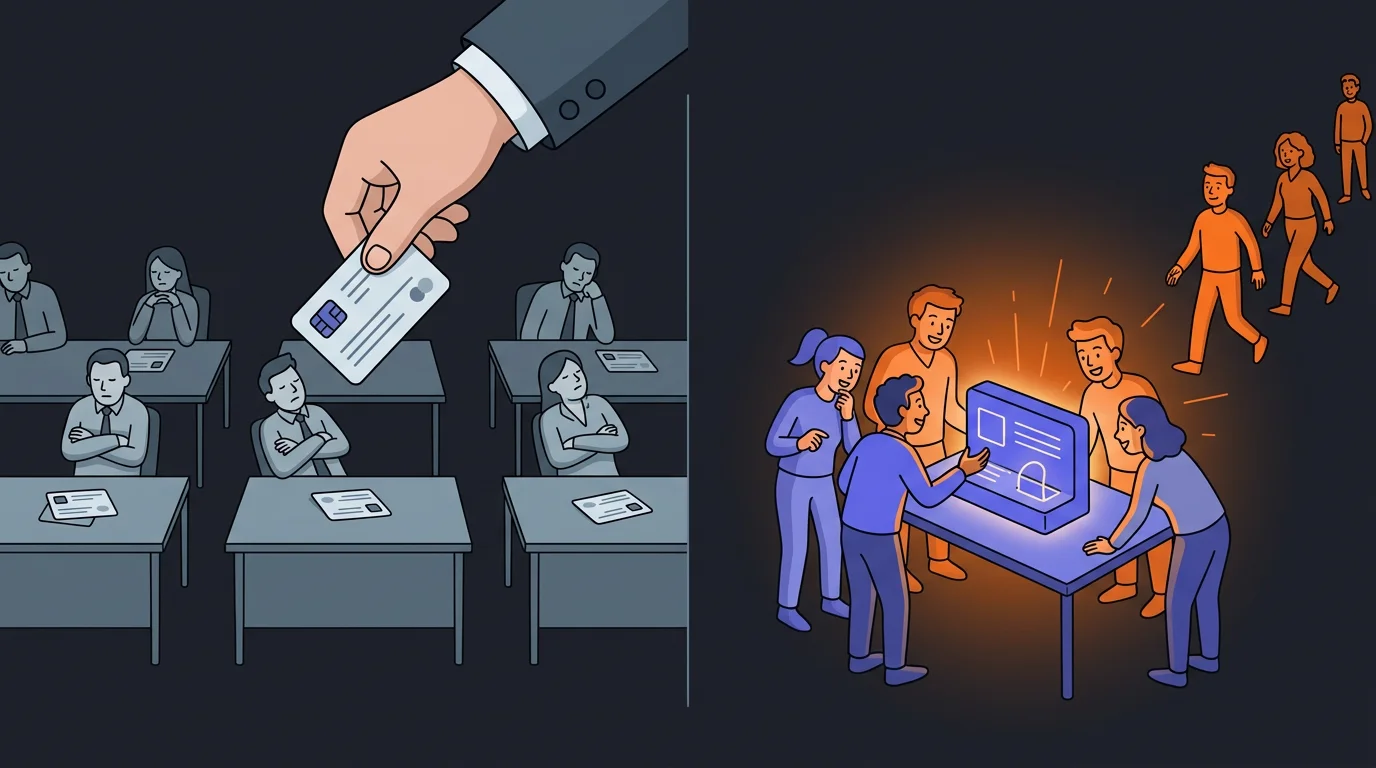
The standard approach is a push: the company decides everyone needs AI, buys the licenses, pushes out the training, and expects adoption to follow. It’s top-down, it’s uniform, and it assumes people will change their workflows because someone told them to.
I tried this once at Carewell — not with AI, but with a project management tool. We rolled out ClickUp company-wide. Trained everyone. Made it mandatory.
The team ignored it.
People don’t adopt tools because they’re told to. They adopt tools that make their lives easier. This is such a basic truth, and yet most AI strategies completely ignore it.
What actually works is a pull: you make AI so visibly, undeniably useful that people want in. They come to you asking how to get started, instead of you dragging them into a training room.
The difference is enormous. Push gets you people clicking the buttons because they have to. Pull gets you people who are actually curious about what the thing can do.
What I’d actually do on Monday morning
If a CEO came to me and said “Okay Fabian, I get it, this isn’t an IT project. So what do I actually do?” — here’s what I’d tell them.
Find your curious people
Every company has them. The ones who are always trying new things, who taught themselves something last weekend just because it seemed interesting, who send you links to stuff they found. They’re probably already using AI on their own — maybe even secretly, because nobody gave them official permission.
Find them. It doesn’t matter what department they’re in. In fact, it’s better if they come from different departments — marketing, sales, ops, product, HR. You want a mix of perspectives, not a room full of engineers.
Give them tools, space, and a loose goal
Give this group access to the best AI tools available. Not just Copilot — give them Claude, ChatGPT, Perplexity, image generation tools, coding tools. Let them explore broadly.
Create dedicated time for this. Call it what you want — a hackathon, an innovation sprint, an AI lab day. But make it real: block the calendars, give it a name, and protect it from “more urgent” work that will absolutely try to eat it.
The goal should be loose but tangible. Not “explore AI possibilities” (too vague, nothing will come of it) but also not “automate the quarterly reporting pipeline” (too specific, kills creativity). Something like: “Find three things in your daily work where AI could make a real difference, and build a rough demo of at least one.”
The key word there is demo. Not a report. Not a slide deck. Something you can show to another person and they immediately get it.
Make them show, not tell
This is the part that does the real work. Everything this group builds or discovers should be demonstrated to others. Not in a formal presentation, just casually: in a team meeting, in the company chat, over coffee.
When a marketing person sees a sales person demo something that AI built in an afternoon, something clicks. Their brain starts making connections: “Wait, if it can do that for them, could it do this thing I spend three hours on every week?”
Most people struggle to transfer one thing they see AI do to another thing in their own work. You need to get as close to what they know as possible. Abstract demos don’t work. Concrete, relatable ones do.
There’s a German saying I love: steter Tropfen höhlt den Stein — constant drops of water wear through stone. That’s exactly how real AI adoption works. Not one big splash, but a steady stream of “look what I just did” moments that gradually shift how people think about what’s possible.
Watch for the pull
You’ll know it’s working when people start coming to you. When someone who wasn’t in the original group says “hey, can I try this too?” When a team lead asks whether AI could help with a specific pain point. When you overhear someone in a meeting say “I wonder if we could use AI for…”
At Carewell, our CEO used our Company AI system to write an application for a startup accelerator. What would normally take him four hours took half an hour — because the system already knew our company, our market, our story. He shared this in the team chat.
Within an hour, someone else approached me: “Can I start using this too?”
That one moment of pull is worth more than a hundred mandatory training sessions.
Why this has to come from the top
I said AI shouldn’t live in IT. But it also can’t just be a grassroots movement with no backing. It needs visible, active support from the CEO and the leadership team.
Not because you need their permission, but because real AI adoption changes how the company operates. Processes need to be rethought. Knowledge that lives in people’s heads needs to be formalized and made accessible. Teams need to share what they know instead of keeping it in their own silos. None of this happens without leadership saying “this matters, and we’re investing real time in it.”
AI strategy is a company strategy. It touches every function: how sales prepares for meetings, how HR onboards people, how product makes decisions, how the CEO runs leadership meetings. That’s not an IT project. That’s an organizational transformation — and transformations need executive ownership.
The part nobody wants to hear
The uncomfortable part: people won’t just magically upskill. They won’t spontaneously redesign their processes. They won’t suddenly start writing down the knowledge they carry around in their heads.
All of this takes intentional effort, and most of it has nothing to do with technology. It’s organizational change, and organizational change is hard. It’s messy. It’s slow. It’s full of setbacks.
But it’s also the only path that actually leads somewhere meaningful. A company-wide Copilot rollout with generic online training will get you generic results. A thoughtful approach that starts small, proves value, creates pull, and builds from there — that’s how you end up with AI that genuinely changes how your company works.
And here’s what makes this urgent: AI knowledge compounds. It’s not linear, it’s exponential. Every week you spend learning and building makes the next week more productive. Which means every week you wait makes the gap bigger. I wrote more about why you can’t just catch up later.
Where to go from here
If you’re reading this as a leader thinking “okay, but what does the actual system look like?” — I wrote a detailed, practical guide on building a Company AI Operating System. It covers the architecture, the knowledge management, the daily habits, everything.
But start here. Get the strategic thinking right first. Understand that this is about organizational change, not software deployment. The tools and systems will follow naturally once the mindset shifts.
And if you’re not a leader? If you’re the curious person I described earlier, the one already experimenting with AI on your own, maybe it’s time to share what you’ve been doing. Show someone. Start the conversation. Be the first drop of water.
And if you’re reading this from inside one of those Copilot rollouts (blocked tools, generic trainings, and all), I wrote the employee-side companion to this guide: Your Company Blocked ChatGPT. Now What?
Published: 2026-02-26
Last updated: 2026-07-18