Building an Enterprise Chatbot That Doesn't Hallucinate: Lessons from 300,000 Conversations
I spent years building and running an AI chatbot at a major Swiss insurance company. Here's what actually matters — and it's mostly not the technology.
 Fabian Mösli
 Reading Preferences
Key Takeaways
- • RAG is only as good as your content. To stop the bot inventing things, retrieve specific verified documents first — and clean, machine-readable, jargon-free source docs end up mattering more for accuracy than anything else.
- • The technology was maybe 30% of the work. The other 70% was cross-functional collaboration, data-privacy compliance, and change management. In my experience it's mostly the well-run companies — clean data, real patience — that get much value out of AI.
- • Don't sleep on your conversation data. Chat transcripts are a goldmine: read sentiment across thousands of chats, watch which topics spike by season, and flag warm sales leads automatically before they cool.
In this guide
Please note: This article is based on a real company and project, with certain details adapted or anonymized to protect confidential information; all figures have been adjusted to remain within realistic ranges without reflecting actual data. I also added a few thoughts I had after I left the project.
Before I started my current company, I spent some time leading the conversational AI and service automation team at a major Swiss insurance company. The team built and ran the company’s customer-facing chatbot — the one that handled over 25,000 conversations per month in 2025, processed thousands of self-service transactions, and reduced follow-up questions on insurance claims significantly.
When the team launched the generative AI version, the company became one of the first publicly listed insurers worldwide to put LLM-powered AI directly in front of customers. The media paid attention. Competitors paid more attention. And we learned a lot of things the hard way.
This guide is about those lessons. Not the technology — you can Google RAG architectures all day. This is about the decisions, the organizational challenges, and the things that almost went wrong.
The journey: from decision tree to intelligence
The chatbot started in 2016 as a rule-based decision tree. You know the type: “Click 1 for claims, click 2 for policy questions.” It recognized maybe 50 keywords and routed people to pre-written answers. Intelligence was nowhere in sight.
By end of 2022, it was clear the old approach had hit its ceiling. Customers expected more. They’d started using ChatGPT, and suddenly every company’s chatbot felt archaic by comparison.
In early 2023, the team rebuilt the chatbot from the ground up with generative AI. Four weeks from decision to launch. That speed was only possible because the company spent years building the foundation — conversation design, brand voice guidelines, an interdisciplinary team that actually functioned. Without those years of groundwork, a four-week GenAI launch would have been reckless.
After the relaunch, things accelerated. Voice integration in the call center. AI-assisted email responses that cut handling time in half. Automated claims filing and coverage checks. What started as a chatbot became an ecosystem — dozens of active AI use cases across the entire customer communication stack.
Five decisions that mattered
Looking back, five architectural decisions shaped everything that followed. Get these right, and the rest is execution. Get them wrong, and no amount of engineering fixes the damage.
1. How do you stop the bot from making things up?
This is the question every executive asks first, and they’re right to ask it. An insurance chatbot that invents policy details is worse than no chatbot at all.
Our answer was RAG — Retrieval-Augmented Generation. In plain language: the chatbot doesn’t answer from its general knowledge. It retrieves specific, verified documents first, then generates an answer based only on those documents.
The knowledge base was built from two sources: automated daily scraping of the company website (so product information stayed current), and hand-curated content we called “custom content” — carefully written documents optimized for AI model consumption.
Every response included a citation: “Based on [source document].” If the chatbot couldn’t find a relevant source, it said so instead of guessing.
This sounds simple. It wasn’t. The quality of RAG depends entirely on the quality of what you retrieve. Garbage documents produce garbage answers, even with perfect retrieval. We spent months rewriting insurance policies and product documentation to be machine-readable — plain language, clear structure, no legalese-wrapped ambiguity. That documentation cleanup turned out to be a very valuable side effect of the project.
2. How do you handle data protection?
In a regulated industry, this isn’t a feature — it’s a prerequisite. And it slows everything down. But there’s no alternative.
Key elements of our approach:
- No training on conversation data. Customer conversations were never used to train or fine-tune models.
- EU-hosted models. All AI model inference ran on servers within the EU.
- Data masking. Personal data was masked before reaching the language model.
- Separate deployment. Our instance ran on dedicated infrastructure, not shared with other customers of the vendor.
- Access-controlled logs. Conversation logs existed (necessary for quality monitoring), but with strict access controls.
Every one of these requirements added cost and complexity. Every one was non-negotiable.
3. Build or buy?
We went with “build and use existing frameworks” — building a chatbot platform as the foundation, then adding significant custom logic on top.
Both ways cost you something.
Building gives you first-mover advantage, deep organizational knowledge, and flexibility. It also demands resources, creates risk if you bet on the wrong technology, and ties up some of your best engineers.
Buying gets you to market faster at lower initial cost. But everyone else can buy the same thing. And you build far less internal capability.
We chose the “build” path because we wanted the first-mover advantage when products were not yet available, and we needed customization that future off-the-shelf products likely couldn’t deliver either. We built everything ourselves: the chatbot platform that handled the conversation infrastructure, the knowledge base, the integration layer, and the behavioral rules.
The right answer depends on your organization’s maturity. If you’ve never built anything with AI, buying first and learning is smart. If you already have a technical team that understands the space, building gives you a durable advantage.
4. How does the bot sound like your brand?
This is where art meets engineering. A chatbot that sounds robotic destroys trust. A chatbot that sounds too human creates uncanny valley discomfort. Finding the right voice is harder than most companies expect.
We invested heavily in prompt engineering for personality. The chatbot had a name, a defined personality, and detailed guidelines covering:
- Formal or informal address (in German-speaking Switzerland, this is a real cultural question)
- Empathy level — how much emotional acknowledgment before getting to the answer
- Humor — when it’s appropriate and when it absolutely isn’t
- Product-specific language — matching the terminology customers see on the website
Getting brand voice right isn’t a one-time effort. It’s continuous tuning based on real conversations, customer feedback, and changing expectations.
5. When does the bot hand off to a human?
The escalation question. Get this wrong, and you either frustrate customers who need a human (bot won’t let go) or waste human agent time on questions the bot could have handled (bot escalates too eagerly).
We built detection for three triggers:
- Frustration. Sentiment analysis flagged when a customer was getting upset. Repeated rephrasing of the same question, negative language, explicit complaints.
- Complexity. When the question exceeded the bot’s knowledge boundaries or involved multiple interrelated issues.
- Regulatory boundaries. Certain topics — legal advice, specific claims decisions, anything involving personal commitments — required a human, full stop.
When escalation happened, the bot made it clear how to get help from human agents. No “please explain your issue again.”
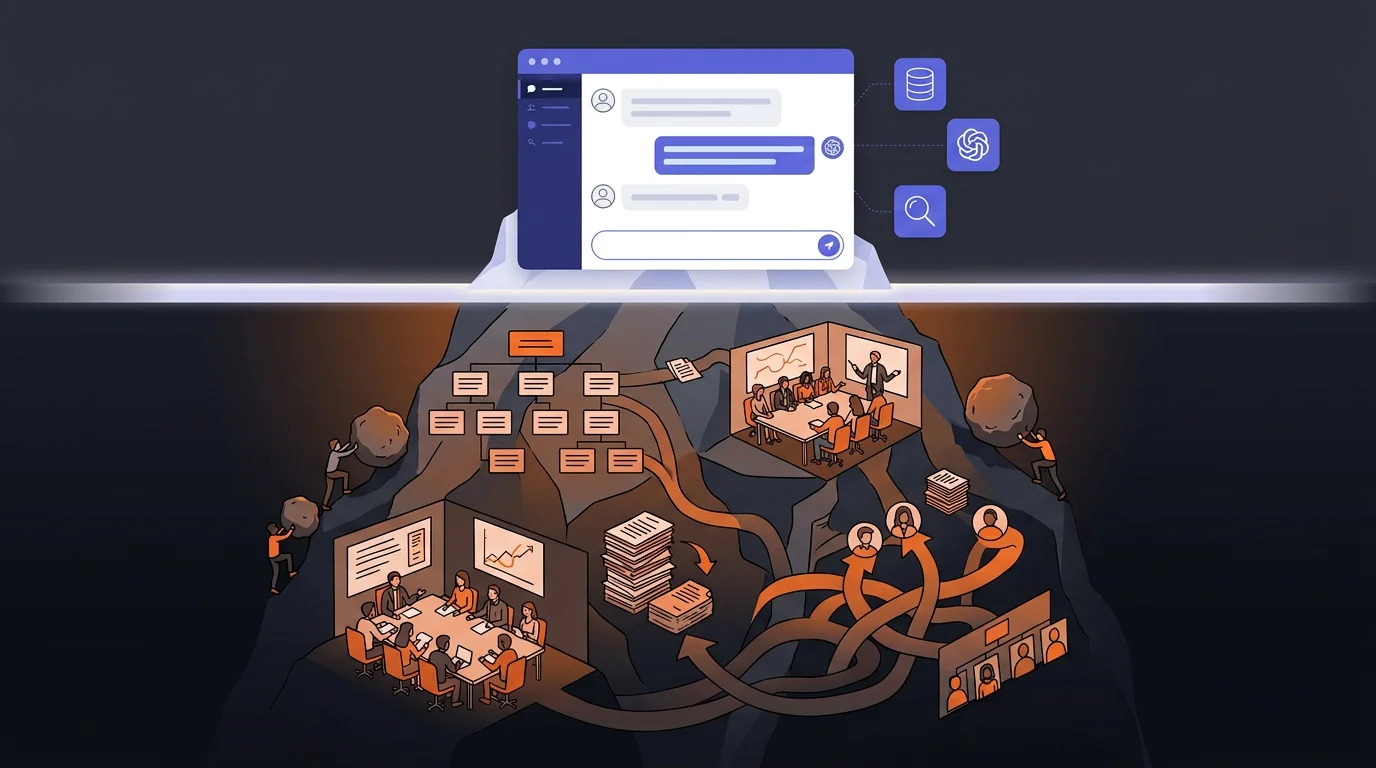
The iceberg
Here’s what I tell everyone who’s building a customer-facing AI system:
What people talk about is on the surface — the visible part of the iceberg. Technology readiness. Hallucination prevention. Prompt engineering. RAG architecture. Data quality. These are real challenges, and they get all the attention at conferences and in vendor pitches.
What actually determines success or failure is below the waterline. And it’s harder to see:
-
Building a business case for something exploratory. If your company can’t invest without a guaranteed ROI spreadsheet, most AI projects die in the planning phase. Do you have the organizational tolerance for experiments that might not pay off immediately?
-
Cross-functional collaboration. Our chatbot sat in customer management. The call center sat in operations. Sales advisors sat in sales. Development, data, and AI sat in IT. Getting all of these groups to work together was harder than building the AI itself.
-
Organizational patience. Do projects end at rollout, or do they get the sustained investment needed to iterate, improve, and prove their value over months and years?
-
Change management that doesn’t feel like change management. People resist being told to adopt new tools. They don’t resist things that make their lives easier. More on this below.
The technology is maybe 30% of the challenge. The organizational and cultural work is the other 70%.
”Bots and Beer”
In the first year after ChatGPT launched, probably fewer than 10% of employees had actually tried AI tools in a meaningful way. Ten percent. At a company that was publicly marketing its AI chatbot.
The team didn’t respond with trying to mandate a training program. Instead, it organized informal sessions we called “Bots and Beer” — casual after-work gatherings with live demos, hands-on experimentation, and actual beer. No slides about “the future of AI.” Just colleagues showing colleagues what they’d built, what worked, and what failed hilariously.
It was change management that didn’t feel like change management. And it worked far better than any formal program would have. Win over a few champions across the organization and the rest follows.
This maps directly to what I call the pull over push principle. Don’t mandate AI adoption. Don’t roll out tools from above. Make it useful, make it visible, make it fun — and let people come to it voluntarily.
The data goldmine nobody mines
Here’s something that most companies building chatbots completely miss: the conversations themselves are a strategic asset.
Do you have detailed transcripts of every phone call your customer service team handles? Detailed enough to analyze sentiment shifts during the conversation? Do you systematically track every topic mentioned? Do you reliably detect sales opportunities in service interactions?
Probably not. Human conversations are expensive to log, analyze, and mine at scale.
But a chatbot captures everything. Every conversation and topic. It tracks shifts in sentiment and questions that reveal gaps in your product, documentation, or process. At scale.
In this mine, there are at least three veins of gold:
Sentiment analysis. Tracking frustration, confusion, and satisfaction across thousands of interactions. Not individual conversations — patterns. Which product lines generate the most confusion? Which processes create the most frustration? Where are customers consistently happy?
Topic mining. What do customers actually ask about, versus what the company thinks they ask about? The gap is always surprising. Seasonal patterns emerge. New concerns surface before they hit formal feedback channels.
Sales signals. A customer asking about life insurance in a service chat is a warm lead. But detecting that requires attentive, present agents — or AI that flags it automatically and routes it to the right team. Leads from chat interactions are warm and they cool fast; speed matters.
The cross-functional potential is where it gets powerful. An address change submitted through the chatbot might signal a recent move — which could mean a new property to insure. A negative sentiment in a claims conversation should flag the next advisor interaction. A surge in product questions is a real-time demand signal for marketing.
Used this way, the chatbot becomes a sensing organ for the whole company. Most organizations haven’t wired up the nervous system to use that data yet.
Honest lessons
I promised transparency, so here are the things I’d tell my past self.
The learning curve is steeper than you think
Most employees — even at a company publicly committed to AI — are still at the beginning of their learning journey. You can’t skip levels. People need time, practice, and psychological safety (permission to experiment and fail) before they’ll genuinely engage with AI tools.
The biggest enabler? Interdisciplinary teams. Not “the AI team builds it and throws it over the wall to the business.” A team with business people, designers, and engineers working together on the same problem. Non-negotiable.
AI projects are transformation projects disguised as tech projects
The most valuable side effects of our chatbot initiative had nothing to do with the chatbot itself:
- Building the knowledge base forced us to clean up years of unclear product documentation
- Automating claims filing forced us to simplify the underlying process
- Deploying in the call center forced us to get our data in order first
Every AI project is also a process improvement project and a data quality project. If you’re not prepared for that, you’re not prepared for AI.
You need air cover from above and energy from below
Neither top-down nor bottom-up works alone. Executive sponsorship gets you budget and political protection. Grassroots enthusiasm gets you adoption and honest feedback. You need both.
Start with the smallest valuable thing. An FAQ bot. Then add self-service capabilities. Then claims filing. Then voice. Then email. Each step builds competence, credibility, and organizational muscle. The company went from one FAQ bot to over 80 active AI use cases in roughly three years — but it happened one step at a time.
The board conversation
At some point, someone has to pitch “let’s put experimental AI in front of customers” to a risk-averse board or leadership team. Here’s what worked for us: framing it not as a technology experiment, but as a customer experience decision. The question wasn’t “should we use AI?” It was “should we miss the unique opportunity to give our customers a better experience than what they’re getting everywhere else?”
And one insight that stuck with me: only well-run companies can use AI well. If your processes are chaotic, your data is a mess, and your teams don’t collaborate — AI will amplify those problems, not fix them.
Where this is heading
The chatbot was the beginning, not the end. The next frontier is voice — handling phone calls with AI that understands accents and manages interruptions. It must also deal with the unique challenges of spoken conversation, like dictating a Polish name or a Swiss IBAN. The company was already processing hundreds of thousands of calls per year through their service center, and progressively routing more of that to AI-powered triage.
Beyond that: a unified intelligence layer across all channels. Chat, phone, email, app, in-person advisory — all feeding into a shared understanding of each customer. The chatbot, the voicebot, the email system, the advisor’s dashboard — all connected. Every touchpoint learns from every other touchpoint.
That’s a vision, not a product. But the companies that figure it out first will have an unfair advantage. And it all starts with that first simple chatbot that answers customer questions without making things up.
What you can do Monday
If you’re thinking about building a customer-facing AI system, don’t start with the technology. Start with these questions:
-
What’s the smallest valuable thing? Not “build an AI customer service platform.” Something like “answer the 20 most common questions automatically.” Start there.
-
Do you have the knowledge? RAG is only as good as what you retrieve. Is your product documentation clear, structured, and machine-readable? If not, that’s your actual first step.
-
Who’s your interdisciplinary team? You need business people who understand the customer, designers who understand the conversation, and engineers who understand the technology. All working together, not in sequence.
-
What’s your tolerance for iteration? The first version will be mediocre. The fifth version will be good. The twentieth version will be impressive. If your organization kills projects after version one, this isn’t for you yet.
You don’t need a three-year transformation program. You need one focused team, one clear use case, and the patience to iterate. The technology is ready. The question is whether your organization is.
Published: 2026-03-17
Last updated: 2026-06-30